

Reflect Orbital's $73.5M Raise: Lessons for LA Hard-Tech Founders
Hawthorne's Reflect Orbital raised $73.5M for sunlight-reflecting satellites. What LA hardware founders can learn about milestones, regulators and critics.
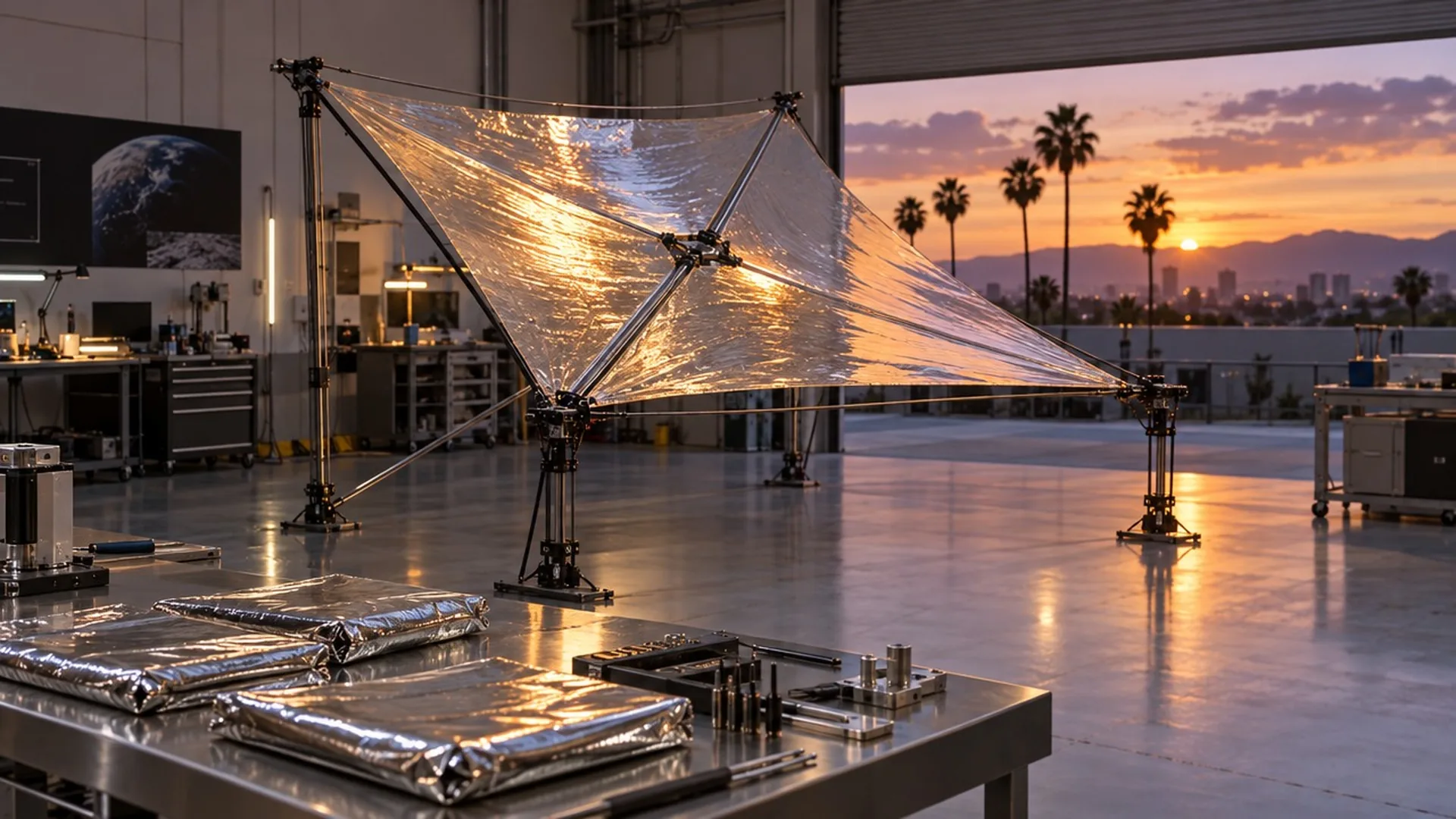
Hawthorne-based Reflect Orbital has raised $73.5 million to keep building one of the more unusual ideas to come out of LA's aerospace corridor: satellites with large, ultra-thin mirrors that would redirect sunlight to specific spots on Earth after dark. The company announced the funding on Nov. 10, bringing its total raised to more than $100 million.
Returning investors Sequoia Capital, Lux Capital and Starship Ventures took part, along with new backers including Buckley Ventures, Convective Capital, The Uncommon Group and Salesforce Ventures. Whatever you think of the concept, the way the company has built and funded itself offers practical lessons for anyone starting a hardware or deep-tech company in Los Angeles.
What Reflect Orbital is building
The pitch starts with a familiar limit of solar power: panels stop producing when the sun sets, often just as demand for electricity climbs. Reflect Orbital wants satellites that stay in sunlight while orbiting and angle their reflectors toward chosen locations on the ground. The company says the light could extend output at solar farms and help search-and-rescue teams or construction crews working at night.
The new money is meant to fund the company's first satellite launches, continued development of its reflector technology and commercial partnerships in energy and lighting, according to the announcement. Reflect Orbital says its first demonstration mission has received approval from the Federal Communications Commission and is expected to launch in the second quarter of 2027. It has also applied to the FCC for a separate developmental satellite to test the spacecraft and its communications payload, and it has purchased two dedicated launches with Skyroot Aerospace.
This is a big step up in scale. dot.LA reported that the company raised a $6.5 million seed round in 2024 and a $20 million Series A led by Lux Capital in May 2025, and that its first demonstration satellite is called Eärendil-1.
Lesson 1: Raise in steps that match real milestones
Reflect Orbital's funding history reads like a ladder: a seed round to build early vehicles and a team, a Series A to keep developing, and now a much larger round tied to getting hardware into orbit. Each step lines up with a concrete proof point.
For LA hard-tech founders, that is the model investors tend to reward. Hardware is expensive and slow, and few backers will fund an entire journey at once. Define the next milestone that would change an investor's mind, such as a working prototype, a regulatory approval or a first paying pilot, and raise enough to reach it with some cushion.
Lesson 2: Turn your factory into evidence
The company's announcement spends real space on production, not just vision. Reflect Orbital says it builds a large reflector section 28 times thinner than a human hair every three and a half days, delivers a four-boom deployable structure each week and builds a 12,000-part satellite from scratch every two months.
Whether you make satellites, batteries or kitchen equipment, a steady build rhythm is persuasive. It shows you can repeat what you did once. If you are raising for a hardware company, track your build times, yields and costs as carefully as your revenue, and be ready to show the trend line.
Lesson 3: Treat regulators as part of the roadmap
For a space company, an FCC approval is not paperwork in the background. It is a milestone that unlocks launch. Reflect Orbital's announcement lists its FCC approval and pending application alongside its launch bookings for a reason.
Many LA startups face their own version of this, from FDA clearance for medical devices to air-quality permits for manufacturing, state licenses for fintech and city permits for food or retail concepts. Put those approvals on your timeline, budget for them and explain them to investors as progress, not risk you hope nobody asks about.
Lesson 4: Get ahead of the people who will object
Reflect Orbital's plans have drawn both interest and controversy, as SpaceNews put it. Astronomers and dark-sky advocates have raised questions about light pollution and interference with scientific observation, dot.LA noted. The company says it is designing around predictability and control, including limiting reflections to defined locations and short periods, publishing satellite positions in advance and avoiding observatories and other protected sites. It also says it plans to begin sharing work from its Impact Science team.
CEO and co-founder Ben Nowack described the company's approach in the announcement as "deliberate" and "science-led." Founders in any category that affects neighbors, whether that is a new delivery robot, a drone service or a nightlife venue, can borrow the idea: identify likely objections early, show your safeguards in public and treat critics as a group you need to answer, not ignore.
Why it matters for LA
Reflect Orbital is part of a dense cluster of space and hardware startups in the South Bay, near suppliers, launch talent and engineers trained at the region's larger aerospace firms. Rounds like this one help keep that talent local and give smaller suppliers, machine shops and service providers new customers.
The technology itself still has to prove it works in orbit, and that test is at least months away. But the playbook, raising against milestones, showing manufacturing progress, planning around regulators and answering critics early, applies to LA founders far outside the space business.